Sterilizing Plant Containers
Like most of our gardeners, we Ricksters think about nature’s health. We want to reuse containers, plastic or ceramic, year after year to grow our plants in. For both human health and plant health, we recommend disinfecting containers now for next spring. Below we’ll walk you through a few techniques for proper container disinfecting, and we’ll keep it short and sweet!
Reasons & Materials:
While cleaning out containers of visible residue is good, most of the harmful stuff is at the bacterial level. Think soilborne pathogens like Phytopythiumand Ralstonia solanacearum- yikes! You don’t want to waste your gardening efforts only to have your plants be killed by preventable pathogens. And don’t forget mineral and salt build-ups too, which can cause dehydration and root rot. Clay pots’ porous nature is infamous for trapping pathogens and minerals, but terra cotta is also a great alternative to plastic (Gedon). We aren’t trying to dissuade gardeners from one material over another; we’re just giving you a heads-up that you will need tools and elbow grease! Here’s a good list:
1.) Dish gloves.
2.) Apron (to protect your clothes from bleach.)
3.) Spare rag.
4.) Old kitchen brush, steel wool, or wire brush.
5.) Household bleach or alternatives (more to come in the article.)
6.) Water.
7.) A tub to wash containers in. We recommend avoiding the bathtub or sink to prevent soil from going into the drain.
How to Clean Containers with Bleach:
First, put on your protective apron and dish gloves. Using your chosen tub, dilute nine parts water with one part bleach, then fill the tub with the mixture (Rindels & Steil). Do NOT mix any other chemicals or cleaning substances with the bleach. Dampen the spare rag with plain water to dab at excess dirt or grime from the containers. Once visibly clean, submerge containers within the tub and scrub the surface with your tool of choice. Scrub both the inside and outside of the container while they’re submerged for a full 10 minutes to kill potential pathogens (Gedon). Rinse the pots with clean water and set them in the sun to dry. Containers can then be stored for winter or be planted with something else (Gedon). The remaining bleach water can disinfect gardening tools; just be sure to dry them properly to avoid rust (Goden)!
How to Clean Containers With Rubbing Alcohol:
Sometimes bleach just doesn’t cut it. Or you hate the smell of bleach. Regardless, there are alternatives to bleach and water. Rubbing alcohol can also disinfect containers (Rindel & Steil). To clean containers this way, complete all steps before creating the bleach bath. Put on your safety gear and wipe all pots clean. Instead of making the bleach bath, spray or wipe all interiro/exterior surfaces with undiluted 70% concentrated isopropyl alcohol. Set them in the sun to dry after cleaning containers this way.
How to Clean Containers with Consan 20:
There is a secret third option to cleaning solutions: Monterey Consan 20. This powerful chemical blend must be diluted and is traditionally used to treat mold, mildew, and other pathogens on hard surfaces (typically man-made). It can be used on plants like lawns and ornamentals with care. Consan 20 can also treat algae in fishless ponds. It can also disinfect non-porous pots, such as plastic pots or fully glazed pots. There’s an instruction booklet on the back of every Consan 20 bottle, with directions for treating pots & houseplant containers on pages 6 through 9. We’ll go through the steps below:
Mix Consan 20 with water in a large tub, following the ratio in the booklet, then pour the mixture into a spray bottle. Spray all surfaces of the pot inside and out, allowing the surface to remain wet for 10 minutes. Spray from 8 inches away to avoid breathing in the corrosive solution. Wipe up excess liquid with a rag once 10 minutes have passed. Make sure to wear gloves throughout all steps!
There you have it, three methods of disinfecting plant containers! Whilst some are more intense than others, each will work perfectly for killing harmful pathogens. Another method to keep containers clean is changing soil out every couple of years to avoid growing more pathogens and mineral build up. Clean containers out every time old soil is removed and before filling with new soil. Happy gardening!
Gedon, Trish. “Sanitize Garden Pots before Spring Planting – Oklahoma State University | Oklahoma State University.” Extension.Okstate.Edu, 10 May 2023, https://extension.okstate.edu/articles/2023/sanitizing_flower_pots
Rindels, Sherry and Aaron Steil. “How to Clean and Disinfect Plant Containers.” Yard and Garden, 20 June 2024, https://yardandgarden.extension.iastate.edu/how-to/how-clean-and-disinfect-plant-containers. Accessed 20 Sept. 2026. https://yardandgarden.extension.iastate.edu/how-to/how-clean-and-disinfect-plant-containers
Fall & Winter Gardening Checklist
September:
-Fertilize lawns while grass remains green. Grass cannot absorb nutrients during dormancy.
-Similar to grass, fertilize trees, shrubs, and perennials before dormancy.
-This is the final month to plant trees, shrubs, and perennials. Use a root stimulator to help encourage vigorous root growth.
-Prune spring and summer blooming perennials.
-If temperatures are expected to dip below freezing, buy a row cover and protect any tender perennials.
-Plant cool-weather vegetables early in the month. These are all great choices: click me!
-Put preemergent down to control weed seed. If you’re planning to spread grass seed in fall, we DON’T recommend putting preemergent alongside it, as it will kill your new grass seed too. Normally, we recommend spreading preemergent in fall and seeding in spring.
-Keep on top of weeding to limit their spread for next spring.
-Remove spring and summer annuals as they fade. You can replace them with fall annuals like pansies and mums.
-Consider collecting seeds from plants you want to continue growing.
-Many perennials can be divided now, like irises, hostas, peonies, daylilies, rudbeckia, and coneflowers.
-Non-hardy bulbs like dahlias should be pulled out of the garden and overwintered soon.
-Slow watering of roses to harden them off for winter.
October
-Plant fall bulbs early in the month before the ground freezes.
-Clear out all old vegetables and annual plants. If none appear to be diseased, they may be composted. Discard diseased and insect-infested plants in the trash.
-Once vegetable beds are clear, consider spreading straw or animal manure to fertilize beds over winter. You could also plant cover crops like alfalfa, red clover, vetch, and annual rye. Learn more about cover crops here: click me!
-Blow out sprinklers and insulate outdoor faucets and hose bibs. Here are some winterizing sprinkler techniques: click me!
-Rain barrels should be cleaned, disinfected, and disconnected until next spring. Allowing rain barrels to freeze with water still inside damages the plastic.
-Create brush piles of fallen leaves and twigs as winter shelter for beneficial insects and birds. For fire safety, keep them six feet away from flammable structures and buildings.
-Clean and store bird baths if you don’t plan on using them over winter.
-Consider overwintering fountains, as even the largest ones can crack open if they freeze solid. We do sell fountain covers.
-You can attempt to winterize container plants; however, we strongly suggest planting all perennials, trees, and shrubs in the ground. Container plants are less likely to survive, and even with CSU’s directions, we can’t promise they’ll make it. Here’s a guide for winterizing container plants: click me!
-Add mulch to newly planted roses to protect crowns from extreme weather.
November
-Clean up all pumpkin debris as soon as Halloween is over. Leaving it out can make wild animals sick and transfer two fatal diseases among deer and elk: acidosis and chronic wasting disease. It can be composted if mixed well.
-Now is a great time to sharpen and clean garden tools. Here are a few sources on how to do that: How to winterize garden tools: click me! Winterizing lawnmowers: click here!
-Winter water from now till May on days over 50 degrees Fahrenheit, as needed. Use wilfpruf to retain moisture.
-Spread seed for plants that require cold stratification. If our winter is warm again, they can be kept in the fridge.
-If you haven’t yet, add mulch to newly planted roses to protect crowns from extreme weather. Add rose collars to small, weak, or more sensitive rose varieties. Here’s a great video on how to winterize roses: click here!
-Think about when you want paperwhites and amaryllis to bloom and plant accordingly! Depending on the variety, paperwhites take four to six weeks to bloom, and amaryllis six to eight weeks to bloom.
December:
-Winter water on days over 50 degrees Fahrenheit, as needed. Use Wiltpruf to retain moisture.
-Purchase and use Wiltpruf for cut Christmas trees.
-Plan for next year’s garden!
Sources:
Dash, Jan. “Fall And Winter Garden Checklist – Pueblo County Extension.” Colostate.Edu, 2026, https://pueblo.extension.colostate.edu/fall-and-winter-garden-checklist/. Accessed 7 Sept. 2026.
“Fall Gardening – PlantTalk Colorado.” Colostate.Edu, 2026, https://planttalk.colostate.edu/topics/fall-gardening/. Accessed 7 Sept. 2026.
Deer-Proof Your Garden
It’s that dreaded time of year for all gardeners: the annual rut. On top of eating up or trampling your garden, male deer notoriously rub their antlers against any young sapling they can to scrape off their antler velvet. This can be deadly to any tree planted in a garden or yard, especially if the bark is scraped off all around the tree, as it limits nutrient flow through the trunk to the upper branches. The best path to resisting deer is to make your yard as unappetizing as possible, both as a food source, resting place, and scratch spot. There are numerous ways to approach deer prevention, but we’ll split it into two categories: now and later.
Deer Prevention Now
Deer prevention “now” is what you should do at the start of the rut and through its completion. This upkeep begins around September and ends in early December. The most effective way to protect any yard is establishing a fence; one tall enough to prevent jumping is ideal. An 8-foot fence is standard for repelling deer and should be made of woven wire (Swift). You can use T-posts or tree stakes to hold in fencing, and for non-permanent fencing, chicken wire and other temporary garden fencing solutions. We likewise understand not everyone can afford or have a temporary fence in their yard, but building protective fence structures is quite affordable and simple. These structures are called plant plot utilization cages (PPUC for short), and you can learn how to build them here: click me. Install PPUC around newly planted perennials, shrubs, and less hardy trees. Similarly, if you really hate the look of temporary fencing, bark wrap or bark guard can wrap around young tree trunks. Our favourite is plastic bark guard, which is heavy-duty and won’t scrape off easily, unlike paper tree wrap. Likewise, plastic bark guard is ventilated due to its grid-like structure, allowing airflow to interact with the bark and prevent fungal infection.
Another popular temporary solution is applying repellents. These are created from substances deer find distasteful, like clove oil or garlic. Repellents can be spread as a liquid or a solid on or around plants. Repellents need consistent reapplication to be effective; rain and general moisture weaken effectiveness. Scent naturally weakens over time without water, too; reapplication can become a chore.
Deer Prevention Later
Deer prevention “later” means creating efficient, long-lasting practices for deer control. It includes building a permanent fence, planning a “deer-proof” garden, and habitat modification. Creating an anti-deer yard takes years of planning and dedication.
Deer try to avoid human activity, preferring silent meadows and forests. With our city ever expanding, silent spaces for rest can now be found in fence-less backyards, amongst ornamental grasses, on hillsides by roads, etc. Water can be accessed in storm drains, bird baths, ponds, parking lot puddles, creeks, etc. Food can be found in poorly maintained compost, gardens, medians, etc. Eliminate deer’s access to your gardens, ponds, and quiet corners. As mentioned earlier, the best defense against deer is establishing a fence. A permanent fence is perfect, as it requires less annual upkeep than temporary fencing solutions. Permanent fencing is undoubtedly expensive and requires permits and permissions for establishment. The next best solution to deer-proofing your yard or garden is to make it unhabitable to them.
You’re less likely to spot deer by roads or sidewalks unless they wish to cross or are grazing on plants near these locations. You’re also less likely to spot deer where dogs are frequent, like backyards or fenced front yards. Areas where people frequent the garden, whether near sidewalks or outdoor dining areas, are places deer try to avoid. These are ideal locations to plant tender plants that deer enjoy eating, as human presence will protect them (UME). Locations away from human activity should host deer-resistant plants (UME). Habitat modification includes making your yard an open space (if fencing isn’t an option), as deer like hiding spots to rest. Annual pruning and debris removal help tremendously, as you’re making a potential habitat unfamiliar and wide open. Avoid cluttering when designing landscapes and limit plants that grow over two feet tall.
What plants to plant in a deer-proof garden? Sadly, there’s nothing truly deer-proof in the plant world, because if they’re hungry enough, deer will eat any vegetation. But deer typically avoid certain plants. Prickly, extra-fuzzy, and strong-tasting or smelling plants, like alliums, are all top contenders for deer-proof gardens. Poisonous plants also make great alternatives but can be harmful to humans and pets too. Here are a few lists for deer-resistant plants:
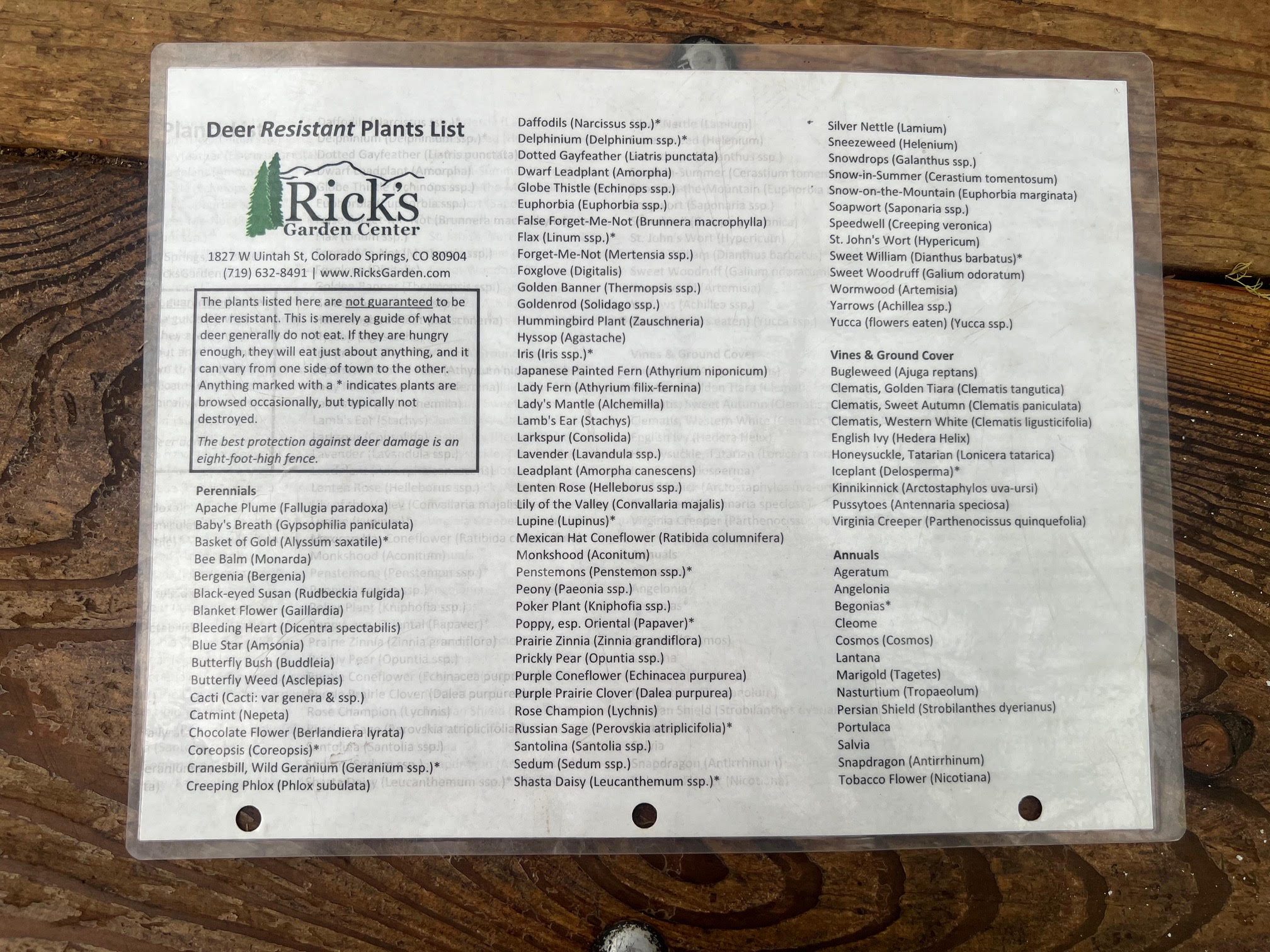
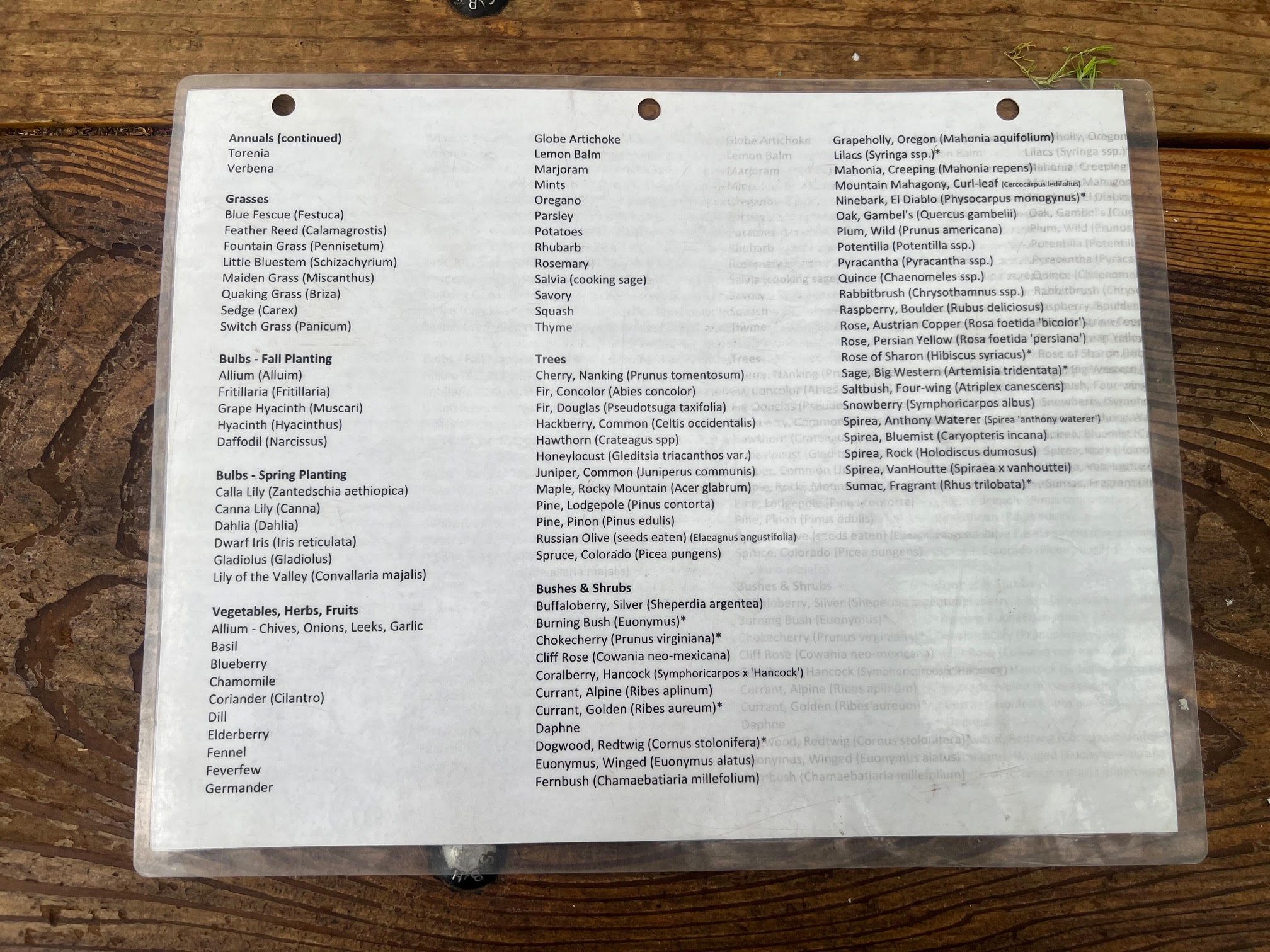
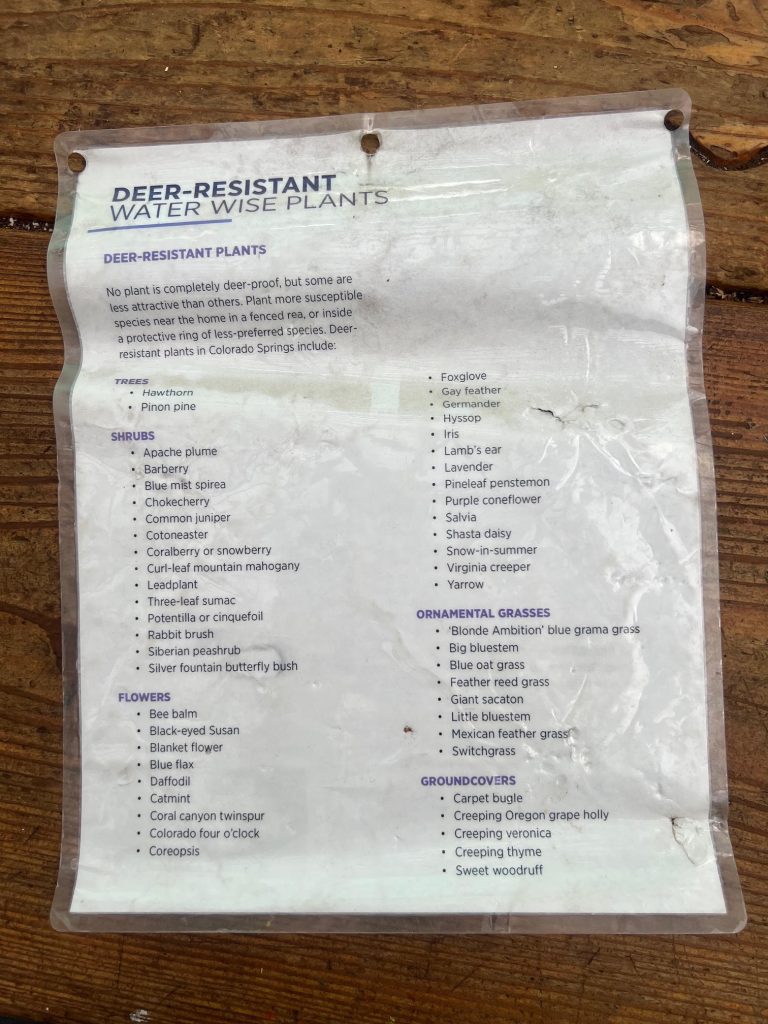
Does Deer Hazing Work?
A short-term solution: frightening deer away using loud sounds, animals, and other means can deter them from encroaching on your property. Motion-activated sprinklers, lights, or noisemakers are popular hazing methods; however, over time deer grow used to the sounds and will return to the garden to graze (UME). Dogs can be used as a hazing method, though deer will learn where they can and can’t go. Ultimately, hazing loses its effectiveness no matter what you do.
Distracting Deer With Food: Bad Idea
Some gardeners use food to distract deer from eating their plants. Others leave compost unattended and easily accessible. Regardless of intention, feeding wildlife in Colorado is illegal (CPW). It disrupts the grazing behavior and teaches deer to search human spaces for food, leading to car accidents or learned aggression (CPW). Feeding wildlife can also contribute to spreading two fatal diseases among deer and elk: acidosis and chronic wasting disease (CPW). Those found illegally feeding deer can face a $ 100 fine, which can be reported through Colorado Parks & Wildlife.
Even though deer are our wild neighbors, they can be destructive forces in the garden. There are numerous methods to deter them presently and in the future. Fencing, creating PPUC’s, and using plastic bark guards make great current solutions, while designing deer-proof gardens is a project for next spring. Repellents work generally but require lots of upkeep. Avoid buying hazing devices because deer grow accustomed to their presence. Do your part to report those who feed deer, as that only worsens their presence in human-populated spaces and leads to death by vehicle or disease.
Colorado Parks & Wildlife (CPW). “Feeding Wildlife.” Colorado Parks and Wildlife, 20 Dec. 2023, https://cpw.state.co.us/feeding-wildlifeAccessed 3 Sept. 2026.
Swift, C.E. “Preventing Deer Damage | Colorado State University Extension.” Colorado State University Office of Engagement and Extension, 2 June 2025, https://extension.colostate.edu/resource/preventing-deer-damage/. Accessed 28 Aug. 2026.
University of Minnesota Extension (UME). “How to Manage Deer Damage on Trees and Other Plants.” Umn.Edu, 2026, https://extension.umn.edu/garden-and-home/yard-and-garden/gardening-in-minnesota/white-tailed-deer-damage#habitat-modification-1880563. Accessed 31 Aug. 2026.
Wasp & Yellowjacket Prevention
August is the time when wasp and yellowjacket activity ramps up. These social bugs become more aggressive in August and are more likely to sting. That being said, wasps are important pollinators for gardens. These insects are naturally driven to hunt other bugs, especially caterpillars, and make great organic pest control. Thus, in this article, we’ll present methods that don’t kill these helpful bugs, just deter them instead.
About Wasps & Yellowjackets: Under-Rated Pollinators
Wasps, believe it or not, do contribute to pollinating your garden. Like bees, they perceive the world in ultraviolet and are attracted to blue and purple flowers (Maryland). In certain studies, the Western yellowjacket is a more efficient pollinator than the honey bee (Maryland). Wasps are carnivores yet require sugar and water for fuel, as it’s a high-energy substance (Maryland).
Wasp and yellowjackets’ carnivorous tendencies ramp up in August as they prepare for winter and wish to feed either their larvae protein-rich foods or themselves. Wasps & Yellowjackets live similarly to bees, meaning a dormant queen wakes up in spring and spends much of the summer laying eggs and creating sterile workers (Polistes). Eventually, old queens create new queens, which leave their original nest to establish their own, intensifying the competition between wasps (Polistes).
While established queens use scavenged meat, whether that be roadkill or something from your picnic, to feed their larvae, new queens consume this protein-dense food for themselves in preparation for hibernation. However, all wasps still rely on flower nectar for a quick energy boost. Naturally, these social insects prefer to hunt caterpillars and other insects amongst the garden, and, unfortunately, non-pest insects as well, because wasps are carnivorous generalists (Maryland). With the wonderful and clear weather, you’re likely enjoying meals on a patio or porch. Wasps’ opportunistic feeding nature makes them bold enough to pursue food from your plate. This is obviously annoying and potentially dangerous to those allergic to stings.
Landscaping & Yardkeeping With Wasp In Mind
If you’re building a garden or plan to, create a spot for these social pollinators that avoid human spaces. Blue and purple-colored flowers are always popular with pollinators, yet depending on the wasp, some are likewise attracted to white/yellow, shallow flowers on account of a short proboscis (Maryland). Don’t plant beebalm, penstemon, and other wasp favroites by the doorway, garden gates, or patio. Instead, keep these plants in less-trafficked areas of the garden, like a bright corner, while planting red and pink flowers where people frequent. Limit pesticide use, which may bring unwanted insects into the garden, yet will distract wasps from your plate by providing them with their original prey. Plus, ladybugs, lacewings, and spiders will likewise take care of garden prey and pests too small for wasps.
Similarly, keep access to water and hummingbird feeders away from people-populated areas. Still water is preferred by wasps, so adding a bubbler to a water feature will deter them from frequenting the area. As for hummingbird feeders, cleaning them regularly and keeping them near screened windows is ideal to maintain visibility when observing hummingbirds.
Keep the garden and yard tidy to avoid attracting these insects. Wasps and Yellowjackets are not picky and will even scavenge from the trash can or compost (Green). Similarly, they will scavenge discarded fruit from trees (Green). Prioritize keeping the yard free of fruit debris, cleaning trash cans, and proper composting so the wasps will not be a problem.
Knocking Down Hives
Wasps and Yellowjackets naturally build their nest in hollowed-out trees, on cliffs or sheltered rock faces, and (for yellowjackets) in underground holes (Laucher). Human homes have become a new favorite for these bugs, and wasps often seek gutters, window frames, garages, porches, and more as potential nest locations. Wasps prefer unbothered locations and to be sheltered from the rain. If you notice signs of hive building, such as a small comb being built, we recommend removing this structure with a large stick at night, as wasps have poor night vision (Green). For your safety, we recommend wearing protective clothes (Green). If you happen to own a red-spectrum light, use it, as it will mask your approach, as wasps cannot detect this visual wavelength (Green). You may have to repeat this action to deter them for good. If you don’t wish to get stung or are severely allergic, you can use a wasp spray to take care of the job. Wasp spray will unfortunately kill any larvae within the comb, along with adult wasps. We recommend using that as a final option when none others work.
As for Yellowjackets and their underground nest, there are very few options for controlling them without extermination. The destruction of their nest likewise must be conducted at night for your safety, with ground-nesting insect spray being the best option (Green). Yellowjackets and wasps found within attics, wall voids, or high-up structures should be left to professional care, and beekeepers should be called to handle the situation (Green).
Faux Nest: Do They Work?
You may have heard that a decoy wasp nest will deter others from searching for a new home. Whether made from paper or crocheted, hanging a faux wasp nest implies your yard is “owned” by another colony of wasps or yellowjackets, creating a non-existent territorial rivalry. Sadly, this isn’t true, as different wasps from different colonies have been observed living in proximity (Polistes). While there are no official peer-reviewed studies on decoy nest effectiveness, wasps have been observed in nature establishing hives in close quarters or even inside/on top of an abandoned nest (click here to scroll and see: click me). In fact, wasps may find the decoys to be excellent new homes and build their hives inside them! Thus, we don’t really recommend a faux wasp nest to deter these insects.
Other Friendly Deterrent Methods?
Unfortunately, the internet is filled with nonsense treatments for keeping wasps away. Peppermint oil partially works, but is limited to the certain oils’ effectiveness, as revealed by this study: click here to see: click here). Citronella is also an effective temporary deterrent, primarily in oil or incense form*. Other than that, there isn’t anything particular that will ward away wasps permanently, as these options are temporary solutions.
Wasps, even though they are generalist carnivores, hunt prey insects and pollinate flowers. They are surprisingly more beneficial to gardeners than we think, but at the same time nuisances and potentially dangerous. A combination of gardening and landscaping with wasps in mind and removing hives is the most effective method of keeping these pollinators distracted and away.
*Keep in mind we are on a fire ban. Incense must be kept away from flammable substances and monitored at all times.
Green, J. P. (2020, June 11). Jody Green, PhD. GRO Big Red. https://grobigred.com/2020/06/11/whats-up-with-all-the-wasps/amp/
Laucher, Daniel. “How to Control Yellowjackets without Harming Bees!” (2016, August 2). Fort Collins Nursery. https://fortcollinsnursery.com/fcn-blog/how-to-control-yellowjackets-without-harming-bees/
“Wasps, Surprisingly Cool Pollinators” – Maryland Agronomy News. (n.d.). In blog.umd.edu. Retrieved July 23, 2026, from https://blog.umd.edu/agronomynews/2020/08/31/wasps-surprisingly-cool-pollinators/
Polistes fuscatus. “Do Wasp Nest Decoys Work?” Ask an Entomologist, 15 July 2020, https://askentomologists.com/2020/07/14/do-wasp-nest-decoys-work/. Accessed 31 July 2026.
Pond Plant 101
By PFC
Having a pond with plants seems at odds with our drought-ridden state, yet it can be a boon to any garden across the western slope. Ponds create a calming atmosphere and provide homes for wildlife, such as dragonflies and frogs, when stocked with the right plants. What makes our state special is its connection to wilderness, so why not try to replicate our waterways, too?
We likewise understand some are more interested in aesthetics. We also supply visually interesting and beautiful pond plants, though a majority of these beauties are not native, sadly. That doesn’t mean native insects and other animals don’t benefit from these plants, however! We’ll provide information on how to care for pond plants, along with some factoids on our favorite native and non-native varieties. Plus, how to safely handle non-native (and often invasive) pond plants. Happy gardening!
Creating A Pond
Creating a pond is easier than you think! If you lack space or want a cheaper option, consider creating a patio pond. These container-sized ponds are made with just that, a container, though it should be fully sealed to prevent water leakage. A pot that lacks a drainage hole, an old bird bath top, or a fountain basin are prime examples. This container should be at least 12” across and 10” deep to provide adequate space for aquatic plants (CSU, “Water Gardens”). For large plants, such as Victoria waterlilies, this may not be an optimal home for their size (CSU, “Planting”). For large ponds, you will have to dig out an area of the garden and line this spot with pond liner to prevent water from seeping into your soil and potentially eroding foundations (Wildlife Trust). To avoid puncturing the liner, remove sharp stones found embedded within the dug-out pond’s soil (Wildlife Trust). Here is an easy how-to guide on creating a pond: click here!
Substrate
Now that we have our container, the next step is substrate! Many aquatic plants, such as water hyacinth and hornwort, don’t require substrate because their roots are free-floating, acting similarly to gills. Things like our taro, zebra rush, and rain lily do require substrate for their survival. Pond substrates come prepacked, or you can forage your own! For packaged substrate, we actually sell bags of our recommended types in the pond section of our store. If you’re looking for more than 2 cu ft, however, we recommend visiting an actual pond store. Our local favorite is Crystal Ponds! (Click here). Sand likewise works as a substrate! Avoid any substrates with perlite, peat, moss, or bark, which will float to the pond’s surface (CSU, “Planting”). When it comes to foraging substrate for a pond, no need to visit a wild lake or aquatic habitat. In fact, the best substrate may just have been under your feet the whole time! Soils beneath cool-season grasses, like the standard bluegrass, make excellent pond substrate (CSU, “Planting”).
Planting
Regardless of substrate type, planting should take place in the shade or on an overcast day to avoid drying out the roots of aquatic plants (CSU, “Planting”). Depending on the type, pond plants must be planted at specific times of year. Hardy pond plants can be planted from mid-April through May, while tropical pond plants should be planted mid-June, when water temperatures are a constant 68 degrees Fahrenheit (CSU, “Planting”). Tropicals can remain in the pond until the first frost. Hardy pond plants can remain in large ponds over the winter after being pruned, yet pond plants in patio pots should be discarded at the end of the season because they will not return the following year (Zuri). If you wish to try keeping tropical pond plants happy in winter (which is incredibly difficult), they can be stored indoors in a makeshift container pond that must have full sunlight and continually warm water temperatures, at least above 60 degrees Fahrenheit (Zuri). Hardy waterlilies should have old foliage removed and dropped within the deepest part of the pond over winter, where they’ll attain dormancy until the following spring (Zuri).
Feeding Pond Plants
Fertilizing pond plants is one of the most difficult aspects of maintaining aquatic plants. This is especially true if you choose to keep fish, as fish (and other aquatic animals like snails and insects) are sensitive to chemicals found in fertilizers, both synthetic and organic. If you have a pond that does not have any animals contained within it nor is it near any wild waterways, you may fertilize pond plants with aquatic plant food tablets. The brand and its ingredients will determine how frequently you can fertilize. A pond with fish can be fertilized but under specfic guidelines. Fertilizer should be organic and animal-friendly! We sell API products, which are animal-friendly pond fertilizers and cleaners. Here is more information on them: click here! We do not recommend fertilizing ponds that are muddy or have undesirable plants within them (MSU). Fertilizer is non-selective, so it will end up feeding weeds and mud (MSU). Mud actually binds phosphorus from fertilizer, causing plants to become unhealthy (MSU).
Native Pond Plants:
This section’s a bit misleading, as at the moment we don’t have any truly native wetland or aquatic plants in stock. We, however, have a solution for you! We highly recommend you visit Highlands Plains Environmental Center (HPEC for short) either in person or on their website for anything native plant-related! We love this place and sell a few of their perennials ourselves, though nothing aquatic yet. To make it easy, we’ve provided a link for you to visit their website: click here!
Hornwort (Ceratophyllum demersum)
If you want to increase oxygen in your pond, look no further than the humble hornwort! This aquatic plant is native to all continents, save for Antarctica, though it’s considered invasive in Tasmania, Australia, and New Zealand (Monk).* Also known as coontail, hornwort is effective at maintaining a healthy pond environment through photosynthesis, absorbing CO2 and releasing O2 back into the water (thewatergarden.com). Highly oxygenated water improves clarity and reduces the risk of algae, positively impacting the health of your pond’s environment (thewatergarden.com). Because of its versatile nature and ability to survive both in pond substrate or floating in water without roots, hornwort spreads rapidly and easily. In the wild, hornwort forms large clumps in lakes, ponds, streams, and rivers, which create safe hideaways for fish hatchlings, dragonfly larvae, and daphnia (MDC). Waterfowl also love consuming hornwort (MDC). This is one of the most essential pond plants there is! These plants are cold sensitive, so they’ll do best in a heated pond. Plant them at a similar time to tropical plants, as they dislike cold.
Non-Native:
Water Hyacinth
A favorite amongst our aquatic gardeners! Known for its impressive growth, the water hyacinth produces beautiful purple flowers. Though the bulbous foliage can look unsightly, the bulbs are filled with air sacs, which increase the water hyacinth’s buoyancy (Michigan.gov). This, along with their feathery roots, incredible growth rate, and asexual reproduction, makes the water hyacinth one of the fastest-growing plants in the world, and thus an excellent invasive plant, which isn’t good for our local waterways (Gladisitch). Keep water hyacinth contained properly and avoid contact with wild waterways.
Taro
Another non-native pond plant. If you’ve visited the Denver Botanical Gardens, you may have noticed these lush-leaved plants alongside the aquatic scapes. They’re also often sold in corm form under their Latin name, Colocasia esculenta, and look very similar to Alocasia. Oftentimes, as demonstrated by the few featured taro within the pond area of the store, they come with colorful or patterned leaves, ranging from “black” colored foliage to leopard-like variegated spots. The taro, so long as it is kept properly wet in pond shallows, can tolerate high heat due to its tropical origins (Pondmegastore.com). It rarely becomes invasive in Colorado, but in Southern states it’s considered invasive. However, unlike many other tropical pond plants, the taro can make an excellent and extravagant houseplant! Its soil should remain continually moist, its lighting should be bright, and humidity is a must if you’re interested in overwintering taro.
Yellow Rain Lily
Though not truly native to Colorado, the yellow rain lily is native to the tropical Americas, primarily Central and South America (Wiki, Nov 2024). The rain lily is also known as magic lilies because they appear right after a heavy rain, blooming from thin air (Chalily). The flowers appear similar to crocus flowers, bright and cheery! In addition to their delightful visuals, certain rain flowers bear a sweet fragrance, particularly at night, which attracts nocturnal pollinators such as moths and beetles (Wiki, June 2024). There are over 3,000 moth species in Colorado, and many are essential to our garden’s health (Powell). Though there is potential for the yellow rain lily to become invasive, if handled with care, it is highly unlikely.
Water Spangles (Salvinia minima)
Also known as water velvet, water spangles are a type of floating fern which behaves similarly to duckweed (ISSG). Originally from South & Central America, water spangles behave similarly to duckweed; thus, they can spread excessively and are considered incredibly invasive (Tulane). It does have an attractive appearance, however, and can make a great cover for fish within ponds and aquariums so long as parts of the plant are occasionally removed to prevent overcrowding (Aquatic Arts). If left untreated, water spangle can easily smother a pond or aquarium, limiting O2 and potentially harming aquatic life, from fish to bugs to other plants. Due to its nature, water spangle should NEVER be near wild waterways.
Working With Invasive Pond Plants
In order to prevent the spread of non-native pond plants into our waterways, you must manage the keeping of and disposing of these plants with utmost importance. Any plant that grows rapidly must be safely disposed of to prevent overcrowding. While you may feel guilty about disposing of these plants, you are being a hero to our native flora and fauna, allowing them to thrive in their natural habitat by preventing ecological competition. There are a few ways to get rid of aquatic plants safely; the best practice is to “cook” invasive plants or to compost them (Mattrick). To cook a plant, simply leave it on a concrete surface and pin it down with a rock (Mattrick). Allow the sun to fry the plant for a month until it’s completely dead, and then it can safely be disposed of (Mattrick). To compost, simply add invasive aquatic plants to the top of the compost pile to dry out and eventually decompose. This should only be done with invasive aquatic plants, as invasive terrestrial plants can still spread seed via compost (Mattrick).
*Hornwort may be native to North America however this variety isn’t historically found in Colorado. Hornwort has adapted to Colorado waterways and isn’t considered invasive
Aquatic Arts. “Water Spangles (Salvinia Minima), Aquatic Arts Grown!” Aquatic Arts, 2026, aquaticarts.com/products/water-spangles-salvinia-minima-aquatic-arts-grown?srsltid=AfmBOorcqi3gRLve-PJDeVJlkSiPGllf7hz0_dEUGKPvzA-lCR7PxO5D. Accessed 29 June 2026.
Gladitsch, Haley. “Water Hyacinth (Eichhornia Crassipes).” Long Island Invasive Species Management Area (LIISMA), 18 July 2022, liisma.org/water-hyacinth/.
“Hornwort. One of the Best Oxygenators You Can Have!!!.– the Water Garden.” Thewatergarden.co.uk, 2024, thewatergarden.co.uk/hornwort-one-of-the-best-oxygenators-you-can-have/.
“How to Build a Pond | The Wildlife Trusts.” Www.wildlifetrusts.org, www.wildlifetrusts.org/actions/how-build-pond.
ISSG. “Issg Database: Ecology of Salvinia Minima.” Archive.org, 2026, web.archive.org/web/20121116204858/www.issg.org/database/species/ecology.asp?si=570&fr=1&sts=&lang=EN. Accessed 29 June 2026.
“Louisiana Invasive Species.” Tulane.edu, 2026, is.cbr.tulane.edu/Species_CommonSalvinia.html. Accessed 29 June 2026.
Mattrick, Christopher . “Managing Invasive Plants: Methods of Control.” Conservation Notes of the New England Wild Flower Society, 1 Feb. 2008. Accessed 29 June 2026.
MDC.“Coontail (Hornwort).” Missouri Department of Conservation, mdc.mo.gov/discover-nature/field-guide/coontail-hornwort.
Monk, Emma. “Hornwort | MPI Biosecurity New Zealand.” Archive.org, Biosecurity New Zealand, 2026, web.archive.org/web/20121205035215/www.biosecurity.govt.nz/pests/hornwort. Accessed 22 June 2026.
“POND|PLANTS|WATER LILIES|WATER|GARDEN|PLANTS|LOTUS.” Pond Megastore, 2026, pondmegastore.com/collections/taro-plants?srsltid=AfmBOopfWXy9FYwzzHfuMhQZRcFz-il_N5m8yzQRNLPUg5Brn0utQHni. Accessed 29 June 2026.
Powell, Lori. “Discovering the Hidden World of Nocturnal Pollinators – Cottonwood Institute.” Cottonwood Institute, 22 June 2026, www.cottonwoodinstitute.org/upcoming-events/hidden-world-of-nocturnal-pollinators/. Accessed 25 June 2026.
“Yellow Rain Lily Shallow Water Plant – Chalily Ponds & Gardens.” Chalily, 22 June 2026, www.chalily.com/product/rain-lily-yellow/?srsltid=AfmBOoqAv_BJILgcYmduz-zWJ1ocGBDGXu6dJtK67K81_kUDiD6-mI_d. Accessed 22 June 2026.
“Water Hyacinth.” Www.michigan.gov, www.michigan.gov/invasives/id-report/plants/aquatic/water-hyacinth.
“1026 – Water Gardens: Planting Aquatic Plants – PlantTalk Colorado.” Colostate.edu, 2026, planttalk.colostate.edu/topics/annuals-perennials/1026-water-gardens-planting-aquatic-plants/. Accessed 27 June 2026.
Wikipedia Contributors. “Zephyranthes.” Wikipedia, Wikimedia Foundation, 29 Nov. 2024.
Zuri, Jennifer. “5 Ways to Prepare Your Pond Plants for a Healthy Winter.” Aquascape, Inc., 22 Sept. 2025, www.aquascapeinc.com/water-gardening/pond-plants/5-ways-to-prepare-your-pond-plants-for-a-healthy-winter?srsltid=AfmBOoo7pwUTah2xSzrEjzrYzZIuLbP0gRZHfq56yqZV4qKgke7Mq5Xg. Accessed 27 June 2026.
Most Commonly Requested AI Plants & Real Alternatives
By PFC
Here at Rick’s Garden Center, we are unfortunately familiar with AI. From misidentifying plant species via plant identification apps to recommending “home remedies” to treat numerous plant diseases that cause more harm than good, we’re familiar with AI wreaking havoc for Colorado gardeners. In fact, it’s become such a nuisance that we’ve already written an article about it this year. If you’d like to check it out, it’s here: click here!
Because our perennials, annuals, trees, shrubs, and houseplants are available for sale, our biggest issue with AI stems from requests for “non-existent” plants. Gardners bring in a picture of a plant that looks too good to be true and want it for their gardens. Examples include plants with unreal foliage, such as perfectly spiraled leaves, perfectly striped, or rainbow-colored flesh instead of the standard green. We hate to break it to you, but that plant you provided a picture of is a computer-generated image, an AI-created plant! And don’t trust purchasing seeds for these generated plants, despite major retail stores listing them for sale; these are typically invasive plant species seeds or duds. Thus, we’d like to provide some pictures of AI plants commonly requested in comparison to the real deal.
Rainbow Hosta
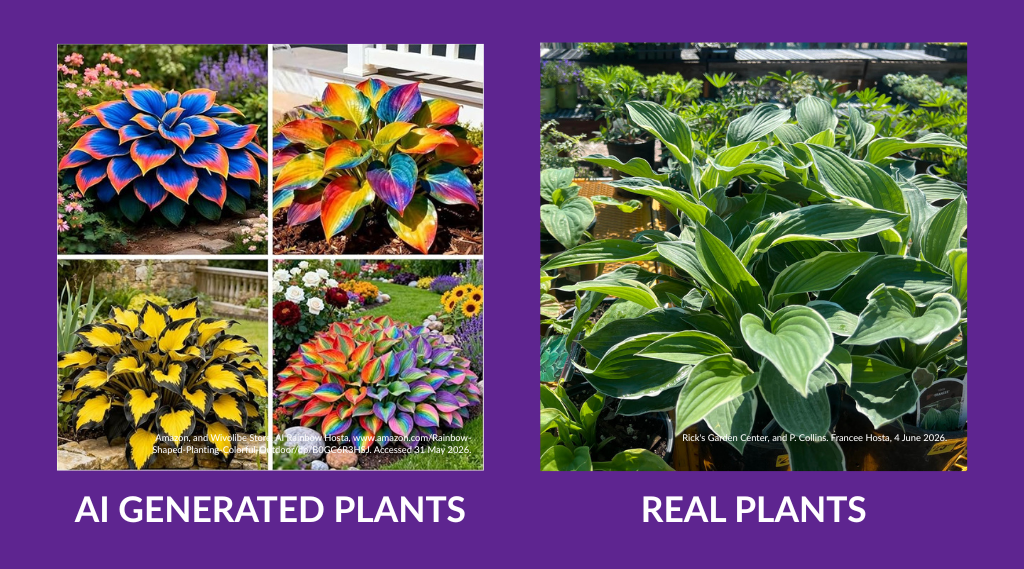
A very popular plant that does not exist! AI-generated pictures display several “types” of rainbow hosta, some quite literally rainbow, whilst others have black or red variegated leaves. A majority of these pictures are fake, all computer-generated. An actual hosta will never contain color multitudes, at best, classic white or dark green variegation. A good example of a real hosta considered to be “rainbow” is the “Rainbow’s End,” which we often don’t carry due to popularity. A beautiful and colorful hosta we carry (and one which likewise exists) would be hosta “Patriot.”
Dwarf Lotus
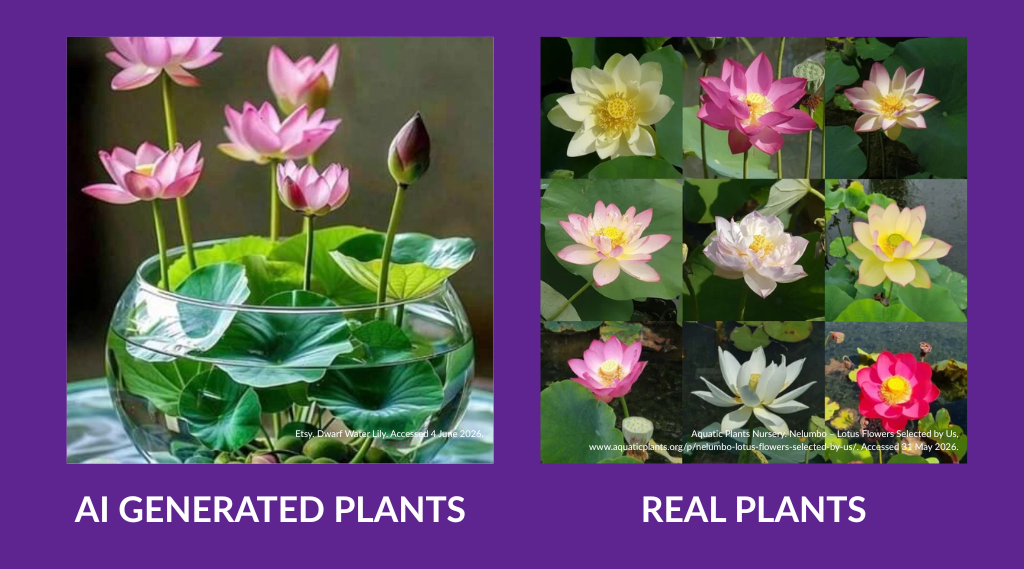
A bit of a trick question plant, as dwarf lotus does exist. The flowers are pale pink or white, and there are several different varieties. However, AI tends to replicate real pictures of dwarf lotus flowers and twist them into fantastical shapes or change colors beyond their usual range, like neon blue*, purple, orange, bright red, and other neon colors. The pink featured in the example image has been artificially saturated, giving the lotus a bright appearance. Plus, if you look closely, you can see “whisp” around the flowers and leaves of the AI lotus. Real lotus leaves and flowers lack such decorative anatomy. We don’t sell lotus rhizomes, but we do sell water hyacinth and other pond plants!
Butterfly Lily
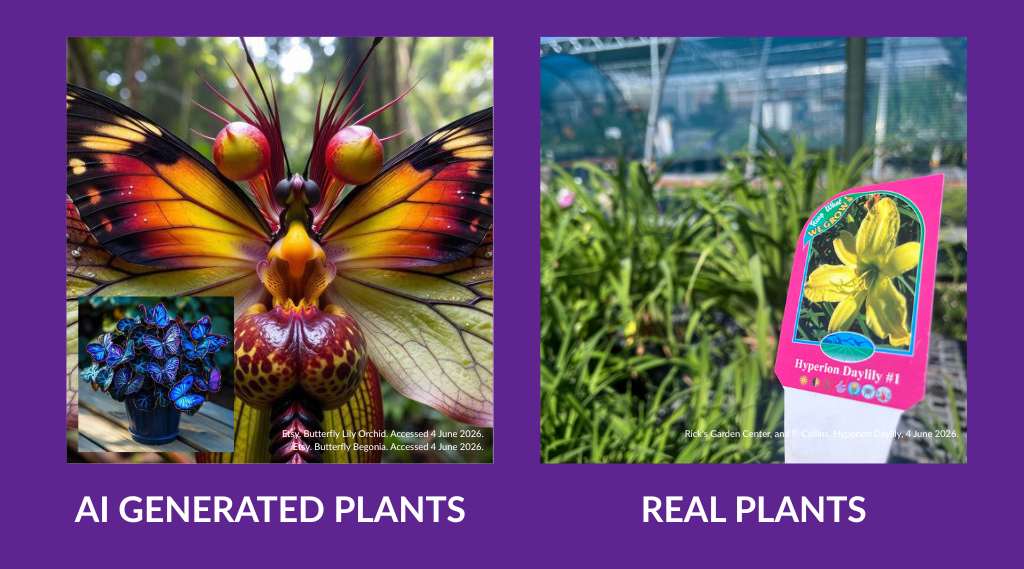
You’ve never seen a lily like this, and that’s because it’s not real. Another common AI indicator is if a plant looks too similar to another animal, object, or other plant. In this case, it’s a butterfly, but things like serpents, elephants, and tigers are common victims of becoming AI plant chimeras. Begonia and orchids are the typical flower victims. Again, there are always weird exceptions, such as the Monkey-Face Orchid (click here to see). If you’re unsure whether a flower is real, we recommend reaching out to Colorado State University Extension for identification. We’ll provide a link to their Q&A page: click here!
In terms of real plants that are visually as stunning, we carry a variety of day lilies in various colors and sizes!
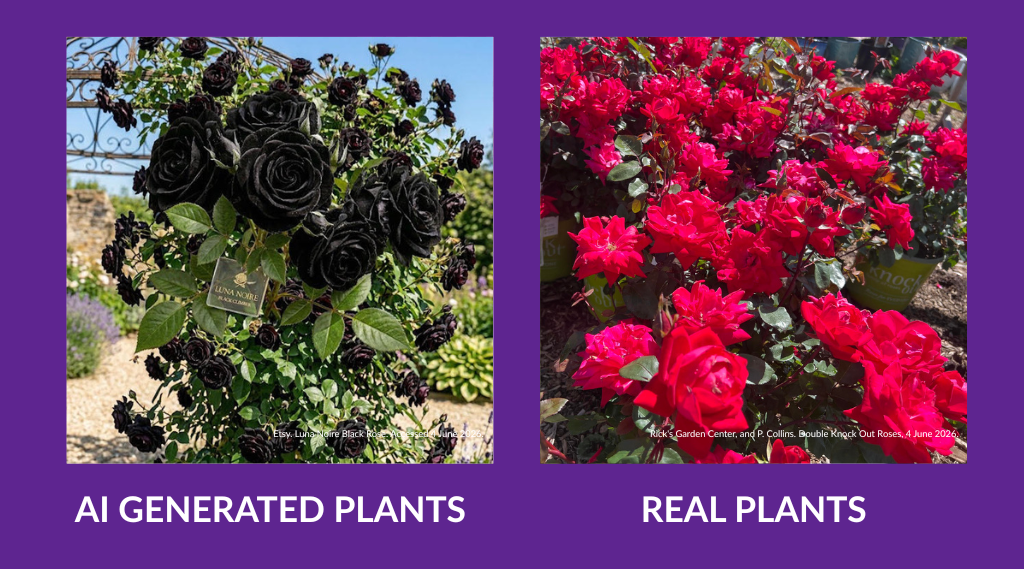
Black Rose
Roses, mentioned in the May 2026 newsletter, are a big focus for our nursery this year. We carry a variety of colors, from red to purple. Black roses, however, are something you’ll never see at Rick’s Garden Center. Black roses don’t naturally occur,as black rose plants are either deep red or purple, or, when sold in a grocery store setting, the flowers are dyed black. AI loves to promote real black rose shrubs as something that can be purchased. If the black appears too deep in tone, it’s probably not real. Likewise, be suspicious of variegated black roses, as those don’t exist either.
Our red roses aren’t dark enough to be considered “black,” but we carry two red rose varieties: “Ramblin’ Red” climbing rose and “Kashmir Red” shrub roses. A “purple” rose we carry is “Lotty’s Love.”
AI shouldn’t be trusted when it comes to gardening. Instead of relying on fantastically generated images for unique species, we recommend exploring plant-oriented locations like the Denver Botanical Garden or the local Xeric Garden! That way, you can identify which plant varieties you want, study their appearance in a garden setting, and then purchase your desired varieties through our nursery. And of course, we are always happy to help identify plants or refer you to Colorado State Extension for help. Don’t go to places like Etsy or Walmart for your exotic plants; rely on experts who are passionate about gardening and not just your wallet. Keep AI out of gardens!
*There is a species of lotus called the Egyptian Blue lotus. Learn more about them here: click me!
Sources For Images:
- Amazon, and Wivolibe Store. AI Rainbow Hosta, www.amazon.com/Rainbow-Shaped-Planting-Colorful-Outdoor/dp/B0GC6R3HSJ. Accessed 31 May 2026.
- Etsy. Dwarf Water Lily. Accessed 4 June 2026.
- Aquatic Plants Nursery. Nelumbo – Lotus Flowers Selected by Us, www.aquaticplants.org/p/nelumbo-lotus-flowers-selected-by-us/. Accessed 31 May 2026.
- Etsy. Butterfly Lily Orchid. Accessed 4 June 2026.
- Etsy. Butterfly Begonia. Accessed 4 June 2026.
- Etsy. Luna Noire Black Rose. Accessed 4 June 2026.
Establishing Roses 101
This year is a big year for roses because we’ve totally revamped our rose selection. Now, our rose selection is handpicked just for front-range planting. A concern for growing roses this year is the wishy-washy weather. Because we had an extreme La Niña winter, warm and dry, there’s no saying how our spring will be. Whether cold or hot, roses need help getting established, even despite the term “hardy” on a rose’s label. They retain their hardy nature as the plants are establishing, but all plants, from the rose to trees, need help getting established. In this article, we’ll walk you through our techniques.
Planting Location
Before you plant a rose, first pick a spot. We presume you have the perfect spot for roses; however, if not, or if this is your first time planting a rose shrub, we’ve got you covered. Location is determined by the rose variety. If it’s a shrub-style rose, pick a spot that allows for room to grow and spread out. If it’s a dwarf shrub rose, you can look for spots between hedge rows or close to a house. The roses should have labels that display their full mature size and space requirements. Avoid planting under a tree, as the established tree will compete with the rose for nutrients and win (American Rose Society). A climbing rose, on the other hand, will require a structure to climb on, like a trellis, pergola, wall, etc. A climbing rose will likewise need to be trained to climb a wall, via placing horizontal wires for the rose to anchor to or stakes (Edmonson). Tying the roses with garden twine, tape, or wire is perfect for a trellis and an obelisk.
The amount of sunlight a rose receives, its protection from winter winds, and soil health likewise determine the rose’s health and lifespan. Roses need 6 to 8 hours of full sun, save for a few shade-tolerant varieties. Strong morning sun is the best for roses as it’s unlikely to fry foliage (Nelson). They also need well-draining soil, as roses dislike clay-heavy soils (Stark Bros). You should not plant roses in heavy clay soil.
Acclimating Roses
It’s not uncommon for roses to be grown in a greenhouse. A few we receive will probably be grown in one, though these roses will never be labeled as such. To be safe, it’s best to treat ALL new roses as though they’ve been grown in a greenhouse. Thus, they’ll need extra TLC to adapt to your yard or garden. First, you should allow a few days for roses to acclimate in ideal weather. There shouldn’t be any rain, snow, sleet, frost, or extreme heat in the forecast. Likewise, you should allow the soil to reach a consistent 50 degrees both during the day and overnight before planting roses (Stark Bros). A rose can survive in various soil temperatures once acclimated; it’s just sensitive for the first year. If temperatures are expected to drop below zero, bring the rose inside.
The delivery teams that transport roses from their greenhouses to our nursery don’t water the plants during transport, so we water them as soon as they arrive at Rick’s. Do the same when you bring them home. As long as they remain in containers, allow roses to dry out between watering to help them harden off. Place roses in the shade or semi-shade for a day or two before planting (Stark Bros). The rose can then be moved to a sunny spot for another day or two, still remaining inside the pot. A light breeze should be felt in spots where roses are placed during this “adaptation” period, as wind likewise helps roses harden off.
Roses can be planted after acclimation and once soil temperatures are consistently 50 degrees. You may see signs of stress, such as wilt or leaf loss, which is common as plants undergo transplant shock. The acclimation process, however, should help alleviate major leaf loss and transplant shock.
Planting Roses
A rose’s planting depth and hole size relate to location. If you plant a rose in a raised bed or location with prepared soil (soil has been repeatedly treated with amendments), dig between 18 to 24 inches in diameter and 14 to 15 inches deep (Nelson). The height of the bud union will determine the depth of potted roses (Nelson). A bud union is the location where new canes emerge and is covered in mulch or soil in cold climates (Arena Rose Company). To accommodate the size of the roses’ roots, give or take a few inches to these measurements if need be. When planting in compacted or untreated soil, the hole should be about 36 inches in diameter and 18 inches deep (Nelson). Aerating near the hole before planting is likewise helpful for loosening compacted soil.
A potted rose should then be carefully removed from its nursery container, gently breaking apart its roots if tightly bound. This is to avoid root encircling, which can be detrimental to any plant’s lifespan (Nelson). Place the rose in the hole dug for it, making sure the bud union is 2” below ground level (Nelson). Cover the bud union when returning dirt to the hole and water the plant thoroughly. Water daily for 3 weeks, especially if temperatures are over 80 degrees (Roebken). You can then limit watering to 2 to 3 days for 12 weeks, until the rose is considered fully established and needs only weekly watering (Minnesota). Water close to the base of the plant and avoid wetting foliage, because it attracts fungus and disease (Roebken). Winter watering is essential for the rose and should be done 3 to 4 times a month until temperatures are above 60 degrees. This technique will also work with bare-root roses; you must plant them either in April or late fall (Nelson). Cover roses with mulch for insulation and water retention.
Fertilizing Roses
Fertilizing roses the first year requires certain rules. You should never use a fertilizer with a high NPK ratio in the first year, which appears on fertilizer bags as a set of three numbers. For example, an NPK ratio of 10-10-10, 20-20-20, or 12-10-11 is too high for the first year. You should look for a slow-release, organic fertilizer (Roebken). One made with chicken manure is perfect! An ideal NPK ratio would be something like 4-5-2, 4-4-4, or 4-5-3. Sprinkle the recommended amount of fertilizer for a newly planted rose (the fertilizer company will have this information on the packaging), and every time you water, the fertilizer goes into the soil to feed the rose. During planting, use as much original soil as possible, opting for topsoil if it’s the only other option. Avoid planting with compost or spreading compost over the bud union in the first year. Fertilize the year after, during early spring and mid-fall. Avoid liquids the first year because of how chemically harsh they can be (Roebken).
Even though it can be daunting, perfecting the planting technique is essential for a rose’s health. Roses are a timeless garden staple that add color and elegance to any garden. Just because they require extra TLC doesn’t mean they should be avoided! If you’re interested in further reading, we’ve provided our sources below for reference. Happy gardening!
American Rose Society. “Right Rose – Right Place – American Rose Society.” American Rose Society, 18 Jan. 2023, rose.org/right-rose-right-place-2/.
Arena Rose Company. “The Anatomy of a Bare Root Rose,” Reagan Nursery. Com, 2000, www.regannursery.com/index.cfm/fuseaction/home.anatomy/index.htm. Accessed 30 Apr. 2026.
Edmondson, Megan. “How to Train and Tie-in Climbing Roses.” David Austin Roses – US, 8 Aug. 2024, www.davidaustinroses.com/blogs/rose-care/how-to-train-and-tie-in-roses. Accessed 1 May 2026.
Nelson, A.W. “Selecting and Planting Roses | Colorado State University Extension.” Colorado State University Office of Engagement and Extension, 10 June 2025, extension.colostate.edu/resource/selecting-and-planting-roses/. Accessed 30 Apr. 2026.
Roebken, McKinsey. “Rose Article.” Received by PFC. 1 May 2026. Email Critique.
(McKinsey is one of our favorite landscapers to work with. Her company is 2 In The Garden, her company phone number is (719)761-0289.)
Stark Bro’s. “Choosing a Location for Roses – Stark Bro’s.” Stark Bro’s Nurseries & Orchards Co., 2026, www.starkbros.com/growing-guide/how-to-grow/garden-plants/roses/location. Accessed 27 Apr. 2026.
University of Minnesota. “Watering Newly Planted Trees and Shrubs.” Umn.edu, 2018, extension.umn.edu/planting-and-growing-guides/watering-newly-planted-trees-and-shrubs.
Guide To Hardening Off Tender Plants
2026 Tomato & Pepper Book
Growing Onions 101
Our onion, leek, and shallot sets have just arrived, which means it’s soon time to plant them! These flavorful plants are a clear favorite for cooking around the world and are surprisingly easier to grow than most expect. But there’s a first time for everything we understand, so with the recent arrival of these bulb producers, we thought we’d write an easy guide to allium care! So, don’t sweat about day length, fertilization, fungal disease, and soil types; we’ve got you covered!
Onion Day Length Guide Explanation
Figuring out and finding an onion that fits your area’s “day length” standards is initially intimidating. “Day length, that is, the duration of daylight hours within 24 hours, is influenced by the Earth’s tilt. Thus, various amounts of light reach different parts of the Earth throughout the year. Likewise, latitude influences what onions you can and can’t grow. Places with higher latitude (the closer you get to the poles), your day length is extended in summer” (Jameson). This is flipped for places closer to the equator in winter. Certain onions won’t survive beyond the equator, while others won’t survive near the equator, as onions are extremely light-dependent. Now, to keep it simple, our store typically only carries onion varieties suitable for Colorado, which typically has Intermediate-day summer growing periods. You can likewise grow Long-day onions further North in our state. To find out what day-length range your state is, click the link here: Click me!
Planting Time
“Plant onion sets from April to early May (for zone 4) or four to six weeks before your last frost date. If your soil isn’t workable, onion sets can be stored for roughly three weeks in a cool, dark, and well-ventilated space” (Dixondale). DO NOT put them in water.
Perfect Soil
One perk about onions is that they grow well in a variety of soil types! “So long as your soil has excellent drainage, to avoid rot, you can grow onions in sandy or clay-dense soil” (CSU). Just make sure to amend said soils with organic material to generate better aeration (especially for clay soils). We recommend organic materials, such as Cotton bur compost or humus, to help. The onions wouldn’t shy away from nutrient-dense soil! “To amend soil for onion beds, you’ll apply 1 1/2” of green compost or humus over the desired beds, and work said material 8” deep into the soil” (CSU). Likewise, the spot onions will be planted in MUST HAVE good sun (exemplified in the day-length paragraph).
Fertilizing
Start strong with fertilizing your onions by testing your soil. You’ll want a nutrient-rich soil with a balanced NPK ratio with no excess. “Onions require a good dosage of nitrogen; however, too much leads to early maturing and produces poor bulbs. While liquid fertilizers are fine for onions, slow-release solid fertilizers are better, especially if they’re organic. You’ll side-dress onions to fertilize them by scratching in the slow-release fertilizer above ground six inches away from the onion plants. You will want to do this after roots establish and only once or twice per growing season” (UM).
Watering
“Onion roots are shallow and thus sensitive to changes in moisture. Make sure to water frequently, never allowing their soil to dry out. If you allow them to dry during the bulbing stage, bulbs will be small and leathery” (CSU). Our 2025-2026 winter has been dry, and our summer will be too (most likely), so make sure to water your onion sets from now until harvest. An inch of water a week should be perfect, but keep a close eye on them regardless. “Cease watering entirely by August, or when the tops of the plant lie over on the ground. The food made in the leaves will supply the onion with nutrients from this point on” (CSU).
Fungal Issues & Insects
Sadly, it’s not all champagne and caviar with growing onions. “One infamous insect that loves onions are thrips” (CSU). These tiny flying lice-like bugs feed by puncturing leaves and sucking out the sap. They especially love onions, so non-systemic insecticides are essential for keeping them away and exterminating them. Onions also suffer from various fungal issues and diseases, from purple blotch to mildew. Always stick to organic fungicides when protecting onions and never systemics, otherwise you won’t be able to enjoy your crops! If you’re interested in learning more about onion diseases and fungal issues, check out a few articles featured below:
Disease & Fungus: Click me!
Insect Control: Click me!
Soil-Borne Diseases: Click me!
Weeds
Onions are susceptible to weed choking. “Get onion beds free from weeds with organic preemergents (such as corn meal), raking them into the top inch of the soil” (Dixondale). Preemergents will halt weed seed germination for six weeks, but established weeds will remain. Do not use any other herbicide and weed by hand with a hoe, dandelion popper, etc.
That’s just the basics when it comes to growing onions, shallots, and leeks from sets. For further questions, we highly recommend you check out the sources below or the others featured within this article. Feel free to visit the store for help from our staff or email Colorado State Extension Q&A for questions. Don’t let the onions frighten you, happy gardening!
Jameson, Molly. “Understanding Short-Day vs. Long-Day Onions | Panhandle Agriculture.” Ufl.edu, 2024, https://nwdistrict.ifas.ufl.edu/phag/2024/07/26/understanding-short-day-vs-long-day-onions/
“1808 – Growing Onions from Seed – PlantTalk Colorado.” Colostate.edu, 2025, https://planttalk.colostate.edu/topics/vegetables/1808-growing-onions-seed/
“Growing Onions in Home Gardens.” Extension.umn.edu,https://extension.umn.edu/vegetables/growing-onions
“Onion Planting Guide – Dixondale Farms.” Dixondale Farms, 16 Apr. 2020, https://dixondalefarms.com/onion-planting-guide/?srsltid=AfmBOopg3208TqFNnzA7QA7bRfa1G1ElBS05UPDSmU2tczB506uMrrrB