
Forced Bulbs 101
Posted by PFC on Nov 15th 2026
Do you want beautiful, living flowers in the dead of winter? Consider learning how to force bulbs to grow! This is commonly done with amaryllis and paperwhites, but other bulbs can force bloom too-with a few exceptions. We’ll cover ingredients, ideal bulb types, and a step-by-step guide to creating the best container for the bulbs. This guide does not apply to bulbs planted outdoors.
Chilling Bulbs
Firstly, what bulbs can be forced? Amaryllis and Paperwhites are obvious choices. Any spring-blooming bulb is ideal, so fall bulbs like tulips, daffodils, and hyacinths make perfect forced blooms. Confusingly, these bulbs are categorized and sold as “fall bulbs” because they must be planted between late September and early November, and they bloom in spring. Unlike amaryllis and paperwhites, fall bulbs need a “chilling period” to emulate the winter dormancy essential to blooming. Depending on the variety, it can take 12 to 18 weeks of storage within a refrigerator or cold, dark basement to recreate this natural cycle. Fall-bulbs cannot be stored in the freezer; they need a space that won’t fall below 20 degrees Fahrenheit (Mahr, Joy, Hudelson). The temperature and humidity shouldn’t fluctuate for chilling bulbs; otherwise, you risk bulb rot and eventual death. Here's a chart to reference chilling periods:
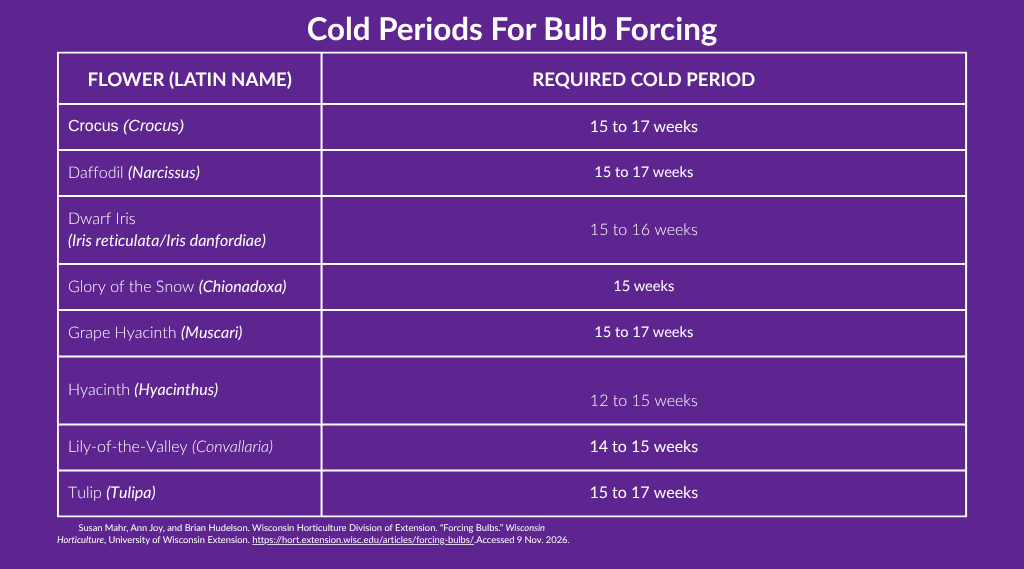
While you can store fall bulbs in a paper bag in a fridge, excessive moisture contributes to bulb rot if the bag gets wet. Plant fall bulbs in the containers you want them to bloom, then store them in the fridge or basement during their chilling period. The next section focuses on which growing medium works best for bulbs. Once the chilling period is complete, bring chilled fall bulbs into a warm and sunny spot indoors.
Growing Medium For Forcing Bulbs
We recommend certain growing mediums for certain bulbs to avoid bulb rot and over-fertilization. Amaryllis are native to arid parts of Cape Africa and South America. To thrive, we recommend planting their bulbs in a succulent & cacti mix. Paperwhites and other fall bulbs require a blend between soil and a well-draining substrate, like gravel, pumice, lava rock, or perlite. The soil should be nutrient-dense and organic to avoid chemical burn. Our personal favroite soil is Ocean Forest by FoxFarms or Happy Frog. Fertilome Ultimate would also work, but you’d need to fertilize these bulbs later if using this sterile soil. Do NOT use Miracle-Gro. Mix oil and well-draining substrates in a 1:1 ratio for paperwhites & fall bulbs.
Gardeners can use water to force bulbs. Typically, specialty containers are used, similar to hourglasses. The bottom chamber is filled with water, while the open section holds the bulb. The bulbs can then drink from the bottom chamber without rotting because the roots can still access water. You can use this method for a season, but the bulbs won’t last if kept permanently this way, even with hydroponic fertilizer. If you want to use the same forced bulbs year after year, we recommend planting them in substrate.
Container Planting Guide
Now that you have your bulbs and soil blend, it's time to plant! Container size and type vary depending on your personal aesthetics and how many bulbs you wish to keep. For amaryllis bulbs, we recommend planting one bulb per container, with 1” of space around all sides of the bulb. Paperwhites and fall bulbs look good in odd numbers, similar to landscaping. But they must have at least 1” to 3” of spacing between other bulbs and the container, depending on the bulb variety. Bulbs should never be so close that they touch. Here's a guide we’ve written before that applies to this kind of bulb planting: click here!
The soil recommendations we’ve provided will only go so far if there's no proper drainage. As mentioned before, rot will kill bulbs. Make sure your container has drainage holes, and drain the pot in the sink every time you water, or buy a saucer. The container can be made of any material, but the best is terra cotta because it leaches excess water. You may water less if planted in a plastic or fully glazed container.
Plant bulbs with the roots facing toward the bottom of the pot and the single “bud” facing up. Amaryllis can have half of the top of the bulb bare, while other bulbs can have1/3 bare and exposed.
If your amaryllis bulb is wax coated but you want to plant it, there are ways to remove the wax! If you do not remove the wax and plant the amaryllis, it won’t be able to access proper nutrients, or it will rot. Do NOT put the bulb in boiling water to melt the wax off; it will kill the amaryllis. Like peeling an onion, find a small knife and peel the wax off slowly. Avoid damaging the bulb underneath by being gentle and going slowly. Here's a good reference video, with a pair of small cutters being used instead of a knife:click here!
Watering & Fertilization
Though bulbs prefer things dry, that doesn't mean they don’t need water. Before fall, bulbs need a drink before the chilling period, so water them and let them drain entirely until the upper layer of soil is dry. Continue to water them throughout the chilling season, maybe once a month, with a spray bottle. Water normally once they are brought out after the chilling period. Amaryllis and paperwhites don’t need this special watering technique because they don't need to be chilled, so water them once they have active growth and blooming once every 7 to 10 days.
Forced bulbs can be fertilized with liquid fertilizer. Fertilizer should only be applied while the bulb is actively growing, so after the chilling period when leaves are present, or the bud is just starting to sprout. Use a fertilizer high in both nitrogen (N on the NPK chart) and phosphorus (P) for healthy leaf and flower growth. Fertilize every other watering unless directions specify otherwise. Change fertilizer type after the flowers wilt.
After Flowering Care: The Gift That Keeps On Giving
With proper care and timing, you can get flowers year after year from forced bulbs. For the next section, we’ll presume the bulbs have been planted in containers following all previous steps and have finished flowering.
After bulbs have flowered, cut away any withered petals to avoid seed formation. Seed formation takes resources and energy from the bulb, weakening its survival chances. Deadheading flowers will keep forced bulbs happy and healthy. Remove the flower stalk once it's turned yellow.
After flowering, most bulbs will not flower again until the next season, so switch to a well-balanced liquid bulb fertilizer or all-purpose liquid fertilizer. Why fertilize at all if there are no flowers until next season? Fertilizing strengthens the bulb for another chilling period or dormant period and will contribute to another beautiful bloom, too. Bulbs can remain green for months after flowering, so continue fertilizing until you choose to force the bulbs again. For forced fall bulbs, prune all leaves, water them without fertilizer, and place them into the fridge for their chilling time period. For amaryllis, leaves can remain as they’re moved to a dark space around 60 degrees farenehit (Weisenhorn & Meyer). The leaves will eventually brown during this time, which is fine. Do not water the amaryllis for the next 8 weeks as it remains in the dark (Weisenhorn & Meyer). Treat paperwhites the same as amaryllis, but prune the leaves before storage.
It's not uncommon for potted bulbs to be affected by fungal issues and pest over the years. Because many forced bulbs are inedible, it's okay to use systemic fungicides and strong insecticides. Be wary of any weird colored spots, patterns, smells, holes, or damaged growth on forced bulbs. Here are a few references for fungal and insect issues with bulbs:
Fall bulb fungal issues: click here!
Amaryllis fungal issues: click here!
General bulb fungal and insect issues: click here!
With time and effort, forcing bulbs provides beautiful indoor winter blooms! And with proper care, these bulbs can bloom year after year. The global flower industry contributes heavily to environmental pollution and destruction (don’t believe us? Read this: click here ). But keeping and resuing forced bulbs contributes positively to our planet's health by limiting carbon emissions from transportation, growth, and plant litter! Plus, it's a great hobby for those who really miss the cheery greenery of spring and summer. Happy gardening
Susan Mahr, Ann Joy, and Brian Hudelson. Wisconsin Horticulture Division of Extension. “Forcing Bulbs.” Wisconsin Horticulture, University of Wisconsin Extension. https://hort.extension.wisc.edu/articles/forcing-bulbs/.Accessed 9 Nov. 2026.
Julie Weisenhorn and Mary Meyer. University of Minnesota Extension. “Growing and Caring for Amaryllis.” University of Minnesota Extension, https://extension.umn.edu/garden-and-home/yard-and-garden/gardening-in-minnesota/amaryllis. Accessed 14 Nov. 2026.